Posts

Moments Inside Google I/O 2017

Google I/O 2017 is the highly-anticipated and much-improved follow-on edition of Google I/O 2016.  It's evident throughout all aspects of the conference that they took feedback and lessons learned from last year's maiden foray into the Shoreline Amphitheater to make for a much more awesome experience.  Now, I sit here writing this to you from inside the Amphitheatre itself, comfortable in just a thin long-sleeve shirt and jeans, no wind at all (unlike last year), awash in sound from the LCD Soundsystem.  However, I almost didn't write you this story. A Nearly Missed Opportunity The registration window for I/O 17 came upon us.  Stacy reminded me it was time for this, but I balked at the price -- up $150 from last year!  Nevertheless, I still planned to register... until I didn't.  I hadn't realized I forgot until a day after registration closed.  My heart fell through the floor, and Stacy rolled her eyes... Oh Stevo... Oh well... I thought all hop...

Journey to a Fully Custom Pinball Machine - Part 1

Image
The"maker bone" has bit me pretty hard since 2011 when I began working on LEDgoes/BriteBlox and won 3rd place the Apps for Metro Chicago hackathon with Owtsee/headonout.  And while I've worked on a mixture of side projects for profit and fun since, I can't help but note the urge to do more ridiculous things for myself just to say I did them -- not necessarily to make any sort of profit (in fact, most of my projects sink an enormous amount of time spent over several years before true completion), but for the notoriety. The Actual Beginning Of This Post There... Now that the part Google Plus will post as the headline is out of the way, it seems to me that my coworkers generally love me, and I love them too.  I am seen as quite the maker type inside my area, and have been invited to participate in events even in various groups I don't necessarily belong to because they like to "claim" me.  Often, these are external recruiting events, and I love exuding...

My Journey With Implementing JPA

There comes a time in pretty much every programming project when you need to communicate with a database of some sort.  When doing this in Java, one choice is to manipulate DriverManagers or DataSources directly.  However, if you want to take advantage of POJOs to represent your data from the database, manipulating data as objects, you might be staring down the task of writing all sorts of ugly reflection code or a really long constructor to make this happen.  There is an alternative: the Java Persistence API. Old news, buddy! JPA is old-school, clocking in at over 10 years old!  (Jeez, I might as well bust out my IBM 5150 .)  However, I did not feel like writing reflection like what was done on the last project, so I searched for an alternative.  JPA provides you a mechanism to add in details pertaining to object/relational metadata (ORM), and thus run all sorts of CRUD operations with minimal code, by offering convenience functions for these oper...

Appreciating Huge Light Marquees On Game Shows Of the Past

Image
Recently, I dug up an old email where I was musing on the big marquee on an old television game show called The Magnificent Marble Machine .  It was a very fancy prop at the time, as most television shows of the era relied on art cards with big, bold letters that would be flipped, slid, or otherwise revealed by stagehands upon the emcee's verbal cue.    k Slide it, Earl! ( Match Game ) - Survey Says?! ( Family Feud ) - Sources: YouTube, Game Show Utopia This is about as fancy as it got for electronic graphics on game show props in the 1970s ( Tic Tac Dough ).  However, they never upgraded this board during the 1980s... Source: Dailymotion And a couple shots of the Magnificent Marble Machine game board in action.  Looks like a plain ol' marquee, but really an astonishing feat of engineering given normally chintzy television props, especially for its era... Source: Gameshows Wikia Cashing In On a Fad Now, the Magnificent Marble Machine w...

Inverting And Combining An Open-Drain Signal

Image
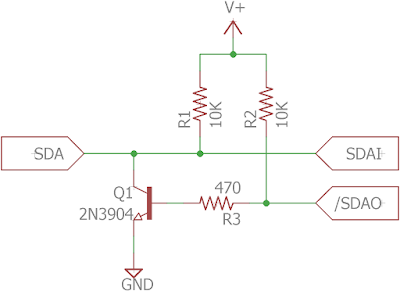
Lately, I have been working with the LTC4151-1 chip by Linear Technology.  It is used to measure voltage and current with high resolution typically in telecommunications equipment.  In the process of validating my design, I need to test it with the simplest circuit possible in order to simplify fabrication and eliminate variables introduced by other intermediate devices (namely, the required optoisolators). The LTC4151-1 chip communicates over the I2C bus.  Only problem: its setup breaks out the SDA (serial data) signal into SDAI (data in from the microcontroller) and /SDAO (data out to the microcontroller, inverted).  It is broken out like this (with SDAO inverted) so that people can conveniently wire up optoisolators to reconcile different ground potentials that exist between the MCU and the unit whose voltage is being measured.  (Many times, the V- out of the battery will not be the same as the GND used by your microcontroller logic, computer, or etc., espe...

Passing "this" Around In Polymer

Lately, I have decided to write the front ends for my personal Web projects in Polymer .  It gives me the ability to construct the UI, and even tie in AJAX actions and database calls , by simply including Web Components as elements in the DOM, just like plain HTML.  To me, it seems less bloated and denser than even Angular 1 (sorry, haven't played with Angular 2 yet), not to mention plain JavaScript or JQuery where you still need to write out most of the interactions between the model, view, controller, and external APIs yourself.  The Web Components aspect was most appealing to me because now I could leverage previous work, standing on the shoulders of giants, rather than reinventing the wheel for the needed interactions.  Better yet, if I use Google's implementations of Web components, I can even get Material styling on my DOM elements with no extra work. However, Polymer suffers from some of the problems I've had with Perl too.  You really need to be in t...