Posts

Showing posts with the label firmware

Getting Started with a Sparkfun ESP32 Thing, ESP-IDF, and Visual Studio Code

I've had a Sparkfun ESP32 Thing laying around on my desk since back in May when I met the fellow from Iron Transfer at a pinball convention, and we got to talking about IoT and his devices to remotely administrate pinball machines.  However, I spent tons of time this year planning for exhibitions, and didn't really get to do anything with it -- until now. Before You Begin There are a few choices you need to make up-front about which IDE you wish to use for development, plus which development framework.  I have chosen Microsoft's Visual Studio Code since it is cross-platform, feature-rich without hogging resources, free to download, and based on an open-source product similar to how Google Chrome is derived from Chromium.  It comes with extensions for language support and IntelliSense, which are must-haves when authoring code.  You are free to use an IDE of your choice; it won't really hamper your ability to enjoy the rest of this article. The other decision ...

Journey to a Fully Custom Pinball Machine - Part 2

Image
From walking the show floor at Texas Pinball Fest 2016, I couldn't help but get the vibe that something novel and big would be in store for TPF 2017 -- something beyond the big but also typical/expected releases of commercial games such as The Big Lebowski and Ghostbusters  (more on those later), but in fact the ushering in of a new era: totally home-brew and open-source pinball.  As the re-themed games became more impressive from 2015 to 2016, and with easy access to leaning about hardware, fabrication techniques to develop new things and restore/renew/improve on old things, and a rejuvenated fascination with pinball in general, it was not surprising to me in the least that we would see someone totally knock it out of the park like Scott Danesi did at TPF 2017 with Total Nuclear Annihilation . However, just in case Scott wasn't there with his amazing game (for which I placed one of the pre-orders slated to ship sometime in 2018), I wanted to produce some work as well in or...

Making a ROM hack of an old arcade game

Image
(Addendum: Follow along my thought process below with this extra pedagogical material:  https://www.slideshare.net/StephenWylie3/process-of-arcade-rom-hacking  ) An interesting work project, right? I was invited to take my Giant NES Controller to a recruiting event for work taking place at a local brewery.  But you can't just have an NES controller without anything to play, right?  Thus, I pitched a couple ideas on custom games to go along with the giant controller since I didn't want participants playing anything standard either.  The thing they agreed to was to feature the Tapper arcade game, by Bally/Midway in 1983, but modified to show the brewery's logo instead of being Budweiser-branded like it was originally. My handiwork, about 80% done, and with a tiny glitch.  Can you spot the remaining issues? Now you might be thinking Tapper wasn't ever ported to NES, and that's correct.  However, with the help of the MAME arcade emulator and a ...

Arduino Day Special: Make an EPROM Tester with an Arduino Mega and Octal Latch

Image
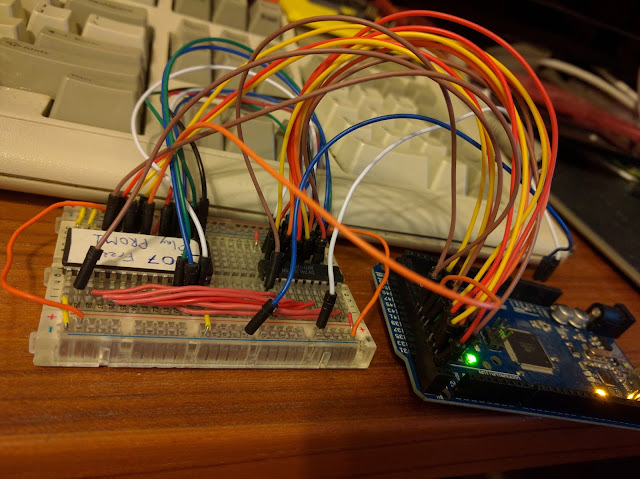
I could have just asked around to see if anyone had an EPROM validator, but why ask when you can spend several hours doing it yourself, and then several more hours writing in pedantic detail about it?  Of course, I must have the DIY bone... Who still uses EPROMs, anyway? While working on old solid-state pinball machines from the 1980s and late '70s, you might run into a situation where a dead ROM chip needs to be replaced.  Certain types of machines (I'm looking at you, all you Gottlieb System 80's) suffer a problem where coils can get locked on due to bad grounding design throughout the system, and then cause transistors and all sorts of other things on the driver board and even possibly the main board to fry themselves.  In other cases, battery corrosion might leech into the ROM chip and possibly compromise it.  No matter what the case is, you might find yourself in need of new ROMs at some point. Now I could easily go and find new ROMs for my game, order ...

Mixing Logic With ISP Circuitry For Programming Firmware

Image
For the LEDgoes manufacturing & assembly stage, it would be desirable to simply secure each board to a programming jig, and the jig would be able to program both chips without hassle or confusion.  This means that we will need to insert a switching mechanism somewhere in between the ISP (in-system programmer) headers and the actual programming pins on the board so only one board at a time gets programmed.  I am quite familiar with digital logic, but don't have a knack for understanding other types of circuitry, so it struck me as a possibility to use some 74-logic to route the signals sent from the ISP to one chip at a time. The 7400 series of transistor-transistor logic (TTL) gates date back to the mid-1960s, shortly after the invention of the transistor itself.  Some chips in this series provide basic Boolean operations, others are counters or shift registers, and still others are flip-flops and latches (memory).  Over the last 50 years, this series has been ...