Posts

Showing posts with the label arduino

A Cold Wind From the USSR - Part 2, Keyboard Emulator for a PDP-11
Image
To read Part 1 of this series, click here . The Russian Elektronika DVK-3 PDP-11 clone is a very fascinating computer to me, and I want to share it with the world.  Part of that endeavor involves allowing people to actually interact with it and play games on it remotely, not just see videos of me using it.  To get this to happen, I need to actually allow people to input into the system via the keyboard.  I could build a ridiculous robotic action to hit the keys on behalf of remote users, but this would likely introduce a great deal of latency into the system and would not be good for those critically-timed Tetris block rotations.  The best bet is to spoof the keyboard by basically building a whole new one, but instead of keys, use an Internet connection and microcontroller to generate the scan codes. The Elektronika MS7004 keyboard is based on the DEC LK201 keyboard interface , standard for PDP-11 minicomputers.  It utilizes the RS423 serial communication st...

Journey to a Fully Custom Pinball Machine - Part 2

Image
From walking the show floor at Texas Pinball Fest 2016, I couldn't help but get the vibe that something novel and big would be in store for TPF 2017 -- something beyond the big but also typical/expected releases of commercial games such as The Big Lebowski and Ghostbusters  (more on those later), but in fact the ushering in of a new era: totally home-brew and open-source pinball.  As the re-themed games became more impressive from 2015 to 2016, and with easy access to leaning about hardware, fabrication techniques to develop new things and restore/renew/improve on old things, and a rejuvenated fascination with pinball in general, it was not surprising to me in the least that we would see someone totally knock it out of the park like Scott Danesi did at TPF 2017 with Total Nuclear Annihilation . However, just in case Scott wasn't there with his amazing game (for which I placed one of the pre-orders slated to ship sometime in 2018), I wanted to produce some work as well in or...

Inverting And Combining An Open-Drain Signal

Image
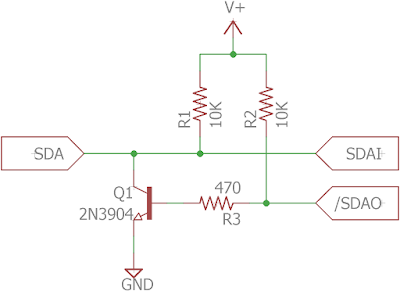
Lately, I have been working with the LTC4151-1 chip by Linear Technology.  It is used to measure voltage and current with high resolution typically in telecommunications equipment.  In the process of validating my design, I need to test it with the simplest circuit possible in order to simplify fabrication and eliminate variables introduced by other intermediate devices (namely, the required optoisolators). The LTC4151-1 chip communicates over the I2C bus.  Only problem: its setup breaks out the SDA (serial data) signal into SDAI (data in from the microcontroller) and /SDAO (data out to the microcontroller, inverted).  It is broken out like this (with SDAO inverted) so that people can conveniently wire up optoisolators to reconcile different ground potentials that exist between the MCU and the unit whose voltage is being measured.  (Many times, the V- out of the battery will not be the same as the GND used by your microcontroller logic, computer, or etc., espe...

The story of those awesome "shaky benches" from TechWeek Dallas 2016

Image
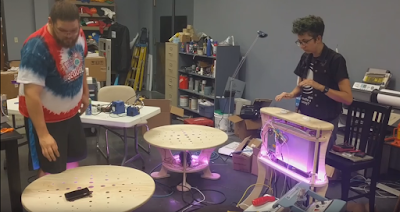
For all this time, I have touted myself as someone familiar and adept at working with hardware, and try to stay on top of all the latest & greatest gadgets in the arena.  Of course, that's very hard to do, and eventually you will find that you've ignored something that virtually everybody else in your circles seems to have already played with.  For me, that was the WS2812 LED strip.  Sure, I've used WS2812 lights recently in an IoT sensor product, but really Stacy wrote that code and we are only driving one of them per board, so it's not truly all that interesting.  Now, it's time for me to get serious with what the WS2812 lights are really meant for. What is (was) TechWeek? TechWeek is an event held in cities across the country. It attempts to discuss various tech trends by bringing together numerous panel discussions on things such as ed-tech [ 1 ] [ 2 ], healthcare , and smart cities , plus individual speakers talking about things like the path to dr...

Arduino Day Special: Make an EPROM Tester with an Arduino Mega and Octal Latch

Image
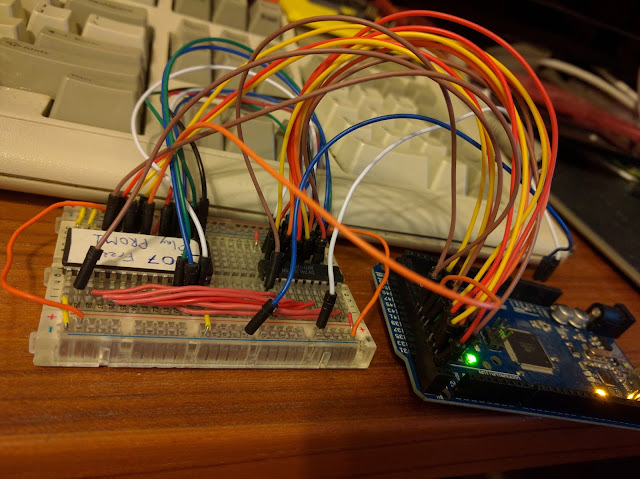
I could have just asked around to see if anyone had an EPROM validator, but why ask when you can spend several hours doing it yourself, and then several more hours writing in pedantic detail about it?  Of course, I must have the DIY bone... Who still uses EPROMs, anyway? While working on old solid-state pinball machines from the 1980s and late '70s, you might run into a situation where a dead ROM chip needs to be replaced.  Certain types of machines (I'm looking at you, all you Gottlieb System 80's) suffer a problem where coils can get locked on due to bad grounding design throughout the system, and then cause transistors and all sorts of other things on the driver board and even possibly the main board to fry themselves.  In other cases, battery corrosion might leech into the ROM chip and possibly compromise it.  No matter what the case is, you might find yourself in need of new ROMs at some point. Now I could easily go and find new ROMs for my game, order ...